The Geometry of Social Trust

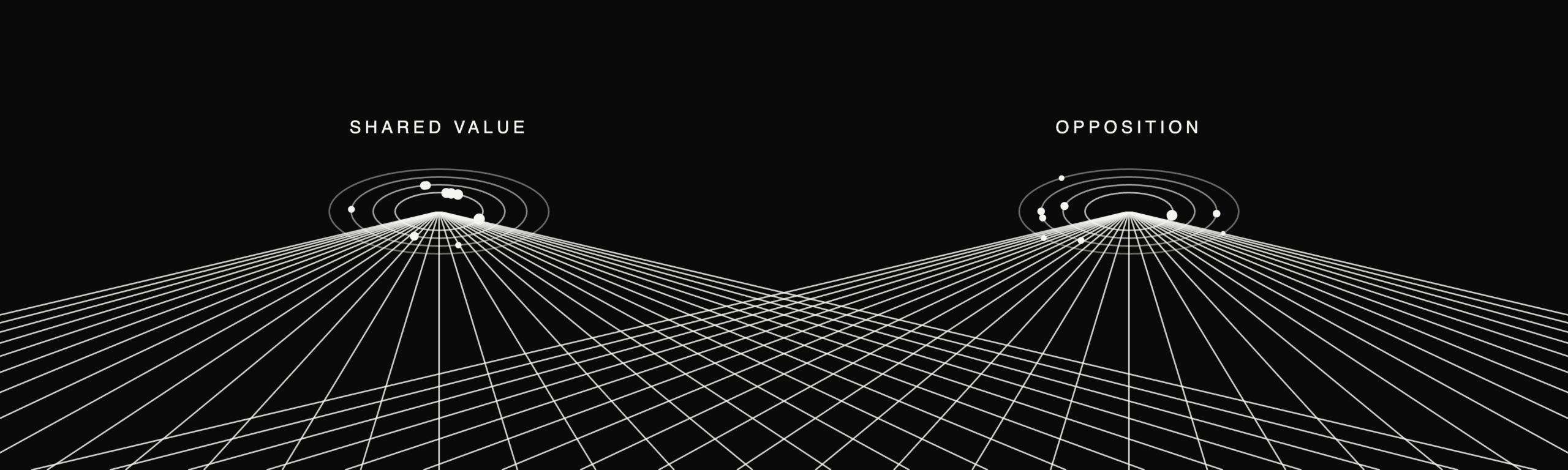
Net zero and the AI era hinge on a single variable no one can predict: social trust.
Abraham Lincoln understood this in 1858: “Public sentiment is everything. With it, nothing can fail; without it, nothing can succeed.” Whether the project is a copper mine, a solar farm, or an AI data center, it depends on the same variable. And no one can predict it.
Billions go to trust-building initiatives, stakeholder engagement, and community programs. A copper company in South America spent over $300 million on social programs and still faced more than 600 days of blockades. Another operator spent a fraction of that on the right things and maintained its license to operate for decades. Same industry. Same geography. Opposite outcomes.
Projects die when a grievance becomes the bridge that connects stakeholders into a coalition faster than commitments can neutralize it. That is the mechanism. And no survey, no dashboard, no stakeholder map can see it forming.
The most dangerous state is the absence of visible conflict. It’s apparent stability — every dashboard green, every report on track — while shared grievances are quietly connecting stakeholders into a system approaching the point where recovery becomes exponentially harder.
No matter the project, this trust-based mechanism remains unchanged.
Camisea
I participated in the research documenting Shell’s $3.5B Camisea gas project in the Peruvian Amazon — as part of an NSF-funded study at UC Berkeley identifying best-in-class sustainability cases.
Shell entered Camisea after the Ogoni crisis in Nigeria, and Brent Spar — the 1995 North Sea oil platform protest where Greenpeace’s consumer boycott cost Shell £10 million a day and forced the most public corporate reversal in the company’s history — had nearly broken Shell. They couldn’t afford another failure. So they did one thing differently: they made binding commitments that directly addressed root grievances — and designed the project around them. They brought in their best environmental managers, spent $15 million on consultation alone, and involved communities in the project’s actual design. Not engagement bolted on after. Shared value by design. The most striking commitment — a “No Roads” policy, helicopter-only access — neutralized the deepest grievance cluster: colonization of Indigenous territory, uncontrolled migration, and biodiversity destruction.
Address the root cause, and the network loses its organizing center. The grievance stops being a bridge. The coalition fails to reach critical connectivity. This creates a positive commitment feedback loop — each resolved grievance makes the next one easier to neutralize. A commitment only works if it changes the condition generating the grievance. If it doesn’t, it becomes evidence of performativity — and accelerates connectivity.
I saw this firsthand — engineers and biologists designing together, communities shaping decisions from pipeline routes to hovercraft design. When Shell’s original hovercraft design clashed with local cosmology, the company redesigned it rather than overriding the concern.
What I discovered then was the commitment feedback loop. I didn’t have a name for it. I’ve been watching the same mechanism play out for 25 years across every consensus-dependent industry — until the data, the tools, and the mathematics finally caught up.
Years later, the counter-evidence arrived: Shell left, Pluspetrol took over the same asset, abandoned commitments, and opened roads. In just a few years, pipeline ruptures followed, rivers became contaminated, Indigenous communities organized across previously disconnected groups, and the Ex-Im Bank rejected financing.
Same asset. Same communities. Opposite outcomes: a natural experiment in trust.
Three things became clear. Social trust depends on whether commitments structurally cover the grievances communities hold — not on the number of meetings held. Stakeholders who share grievances are connected, whether they know each other or not — the grievance is the organizing principle. When commitments fail to address root causes, networks don’t erode — they snap.
Why can’t the current tools see this
The industry has been measuring the wrong thing.
It measures individuals — surveys, sentiment, and satisfaction scores. But social trust is not a property of individuals. It’s a property of the network between them. A mining company signs a benefit-sharing agreement with one community. The neighboring community — which shares the same water source but wasn’t included — doesn’t see a commitment fulfilled. They see a deal cut without them. Trust built with one group, distrust manufactured with another. Same action. Same day.
Because commitments are evaluated relationally, not in isolation.
No survey catches it. No score reflects it.
But the mechanism isn’t mysterious. It’s been described — just not in the industry’s language. Albert-László Barabási spent two decades mapping how complex networks behave: how nodes connect, when systems collapse, why some structures absorb shocks while others snap. His finding that applies here: networks don’t degrade gradually. They flip at a threshold. Below it, the system absorbs shocks. Above it, it breaks. Every project sits inside a stakeholder network that follows these laws. But no one is watching the network form.
And it gets worse. In the effort to compress trust into a single score, every dimension gets flattened. A stakeholder who trusts the operator’s competence but distrusts their intentions registers the same as one who trusts their transparency but distrusts their commitment to follow through. The score looks identical. The underlying reality is completely different.
For three decades, the best tools available have been the Power × Interest grid and the salience model — plot stakeholders, guess who matters. But they’re static. A human guesses once, and the map doesn’t move. It can’t show a coalition forming. The community you marked “low interest” six months ago is now the bridge connecting three opposition groups — and nobody saw it happen. If that’s happening, you’re not early. You’re already late.
If your team is tracking meetings, sentiment, and issue closure, you are measuring activity — not risk.
As Jean Garner Stead recently argued in Poets & Quants, strategic management has spent 40 years answering “how do firms win?” while avoiding the harder question: “win at what cost?” The measurement layer is what makes that question answerable.
Three Measurements
The physicist Fritjof Capra spent his career studying why complex living systems can’t be flattened into a single number. His framing applies directly here: “Quantities can be measured; qualities need to be mapped.” The industry has been trying to assign a number to something that only makes sense as a structure.
Three measurements determine where a project is heading:
- Distance — are you solving the real problem, or performing around it? Distance is coverage. A binding water agreement sits close to a water grievance. A livestock fair sits far away. It is now possible to map grievances and commitments into a shared geometry and measure coverage — turning subjective judgment into geometry. Until recently, this couldn’t be done.
- Density — is the problem compounding faster than you’re resolving it? When grievances converge — water, health, consultation failure clustering together — that density is a signal. The cluster has gravity.
- Connectivity — are you about to lose control? When connections formed by shared grievances cross Barabási’s percolation threshold, isolated groups form a coalition. Below it, shocks are absorbed. Above it, the system breaks.
Distance. Density. Connectivity. The geometry of social trust.
Two Attractors
Complex systems don’t drift. They lock in. Doyne Farmer, who runs the complexity economics program at the Oxford Institute for New Economic Thinking, has shown that once feedback loops in a heterogeneous-agent system are reinforced, the system settles into stable states that become exponentially harder to escape from. He developed the methodology to predict economic behavior. The same computational principles apply to a stakeholder network — because both are heterogeneous-agent systems with feedback. The math doesn’t care whether the agents are traders or communities.
What’s striking is the convergence: I arrived at this structure from 25 years of field observation. Farmer arrived from computational economics. Barabási from network physics. When independent paths converge on the same architecture, it suggests something fundamental.
The network’s structure draws every project toward one of two stable outcomes — shared value or organized opposition. The main determinant is how projects affect social trust through their commitments.
A project that makes an early root-cause commitment weakens the connections between stakeholders linked by that grievance. The coalition loses a node. Trust compounds. The system is pulled toward shared value.
A project that misses the root cause proves to stakeholders that commitments are performative. Grievances cluster. New stakeholders connect through shared frustration. Distrust compounds. The system is pulled toward organized opposition.
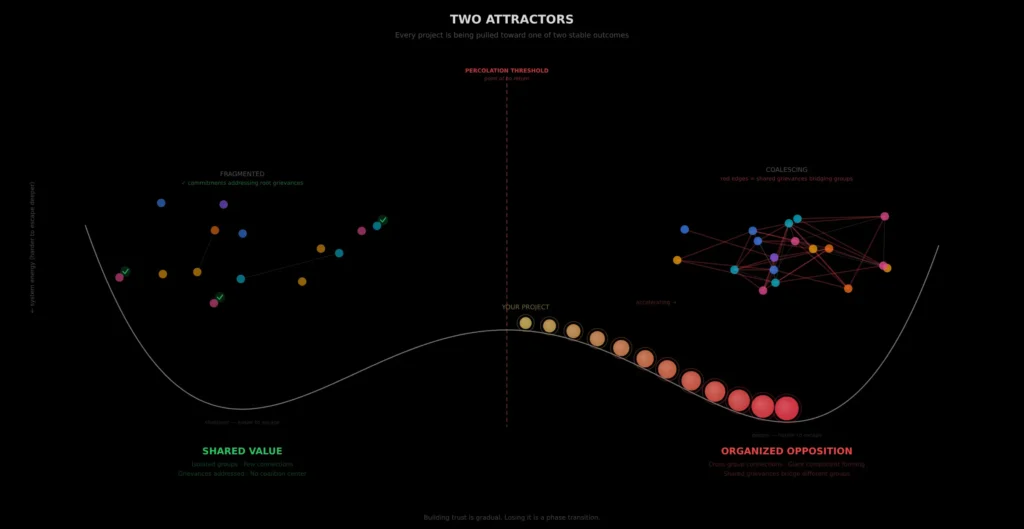
These aren’t points on a spectrum. They’re two stable outcomes — but the dynamics between them are not symmetrical. Building trust is gradual: each root-cause commitment weakens a connection, thins the coalition, and raises the baseline. Losing trust is a phase transition: one broken commitment can re-activate dormant connections faster than years of engagement built them. The deeper a project falls toward conflict, the harder it is to escape — and the cost of reversal grows exponentially. The three measurements tell you which outcome you’re converging on while there’s still time to act.
The industry is blind at three levels — and the three blindnesses map directly to the three measurements. Scores flatten the dimensions (the Distance problem — you can’t see whether commitments are landing close to grievances). Networks have a percolation threshold no one is watching (the Connectivity problem — you can’t see when the coalition crosses the line). Attractors have asymmetric forces (the Density problem compounding through time — clusters concentrate faster than they disperse). Fix one, and you’re still blind to the other two.
Why you’re already late
Demand for copper will triple by 2035. AI data centers consume three times as much copper as traditional facilities. Every solar farm, every mine, every transmission line requires community consent.
Eighty-five percent of the world’s lithium sits on Indigenous lands. The minerals powering the energy transition and AI come from communities with the least history of shared benefit. Without measurement, those projects will be built the way they always have been — with detailed blueprints for engineering, the supply chain, financing, and permits. And no blueprint at all for the network of grievances and commitments that will determine whether the project survives. The network forms anyway — invisible to the operator, visible to the communities — and the project fails.
Worley, the global engineering firm that delivers major mining and energy projects worldwide, put it bluntly: conventional project delivery will not get us to net zero. Dr. Mary Lou Lauria, their Senior Vice President for Global Environment & Sustainability, has seen the pattern repeatedly:
“Over the last 26 years, I’ve seen numerous projects end before they begin. Many were focused on the energy transition, technically feasible, financially sound, and had the right experts and supply chain lined up to deliver. But the community had been ill-informed, brought late to the table, and no time (or process) had been applied to building the necessary level of community relationship.”
And yet the industry is still measuring trust with surveys and static grids — tools designed for a world where you had time to be wrong.
Two weeks ago, 12,000 voters in Port Washington, Wisconsin, passed a first-of-its-kind referendum by 66% to 33%, requiring voter approval for future tax incentives on major developments. The trigger: a $15 billion OpenAI–Oracle–Vantage AI data center campus. The operators’ response to community concerns had been nonbinding guarantees from Big Tech executives — commitments that did not change the underlying conditions generating the grievance. Environmental impact, energy costs, loss of local control, concentration of benefits to outside tech firms: these grievances already existed. The project became the bridge that connected them. A mother who had never organized before. A Wisconsin comedian with three million followers. Voters across party lines. Previously disconnected stakeholders, coalesced by a shared grievance, crossed the threshold in a single vote.
And Port Washington is not alone. Virginia and New Jersey voters flipped statewide elections last November on rising utility costs tied to data centers. Georgia voters removed Republican public utility commissioners. State regulators from Washington to Ohio moved to protect ratepayers. Democratic and Republican governors filed joint comments to federal regulators. Mark Christie, a former Republican FERC chair, warned publicly that continuing to push data center development over every other consideration will “only fuel extreme measures, like outright bans.” Different forums. Same grievance. The same coalition is forming. The mechanism is live — and it is not local.
The context that determines whether a project survives — who connects to whom through which grievance, which commitments cover which root causes, what happened at another project under the same conditions, and how those patterns repeat — lives scattered across field reports, legal filings, and the institutional memory of people who were there. Until recently, this wasn’t computable. Now it is.
A causal context graph. A live model that maps which commitments change which grievance-generating conditions — and how those changes propagate through the stakeholder network.
That is the missing instrument.
For the first time, we can measure social trust at the network level. Not as a score. As a geometry.
By the time conflict is visible, the decision has already been made — by the network. When you can see the geometry, you can design for shared value rather than stumble into conflict.
Communities get their real needs addressed. Projects proceed. Capital goes further.
If you’re still relying on surveys and dashboards, you will not see the coalition forming until it is already strong enough to stop you — and by then, outcomes stop being a function of your decisions and start being a function of a network you can’t see.
Source: The Camisea case draws on “Promoting Sustainable Development: Lessons Learned From Camisea,” UC Berkeley Energy & Resources Group (2000), co-authored by the author, and the National Security Archive’s “Broken Promises: The Camisea Pipeline Project at 20 Years” (2024).
Is your project trust-solvent?

Natan Zaidenweber
CEO & Founder
Get the answers. Build durable trust.
Communities get their real needs addressed. Blockades decrease. Capital goes further.
Building social trust to accelerate the energy transition.
That is Shared Value by Design.

PRODUCT
- Trust Context Engine
- Dynamic P×I
- Trust Solvency Ratio
- Stakeholder Intelligence
- Stakeholder Intelligence
- Digital Twin
- Forecast
COMPANY
- About
- Careers
- Contact
LEGAL
- Privacy Policy
- Terms of Service