The Geometry of Social Trust
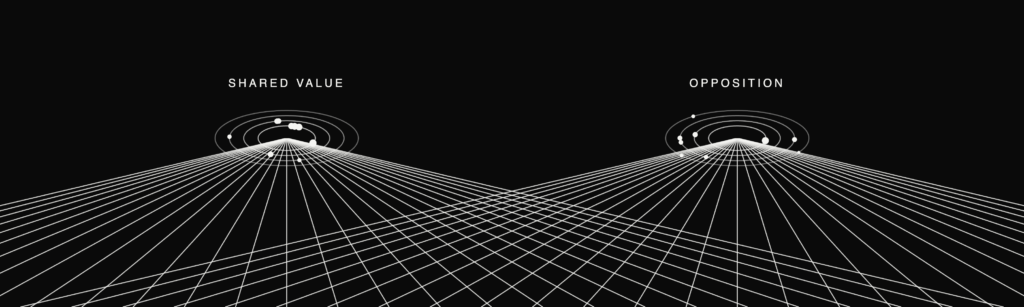
Product Trust Context Engine Blog Request a demo Back to blog The Geometry of Social Trust Net zero and the AI era hinge on a single variable no one can predict: social trust. Abraham Lincoln understood this in 1858: “Public sentiment is everything. With it, nothing can fail; without it, nothing can succeed.” Whether the project is a copper mine, a solar farm, or an AI data center, it depends on the same variable. And no one can predict it. Billions go to trust-building initiatives, stakeholder engagement, and community programs. A copper company in South America spent over $300 million on social programs and still faced more than 600 days of blockades. Another operator spent a fraction of that on the right things and maintained its license to operate for decades. Same industry. Same geography. Opposite outcomes. Projects die when a grievance becomes the bridge that connects stakeholders into a coalition faster than commitments can neutralize it. That is the mechanism. And no survey, no dashboard, no stakeholder map can see it forming. The most dangerous state is the absence of visible conflict. It’s apparent stability — every dashboard green, every report on track — while shared grievances are quietly connecting stakeholders into a system approaching the point where recovery becomes exponentially harder. No matter the project, this trust-based mechanism remains unchanged. Camisea I participated in the research documenting Shell’s $3.5B Camisea gas project in the Peruvian Amazon — as part of an NSF-funded study at UC Berkeley identifying best-in-class sustainability cases. Shell entered Camisea after the Ogoni crisis in Nigeria, and Brent Spar — the 1995 North Sea oil platform protest where Greenpeace’s consumer boycott cost Shell £10 million a day and forced the most public corporate reversal in the company’s history — had nearly broken Shell. They couldn’t afford another failure. So they did one thing differently: they made binding commitments that directly addressed root grievances — and designed the project around them. They brought in their best environmental managers, spent $15 million on consultation alone, and involved communities in the project’s actual design. Not engagement bolted on after. Shared value by design. The most striking commitment — a “No Roads” policy, helicopter-only access — neutralized the deepest grievance cluster: colonization of Indigenous territory, uncontrolled migration, and biodiversity destruction. Address the root cause, and the network loses its organizing center. The grievance stops being a bridge. The coalition fails to reach critical connectivity. This creates a positive commitment feedback loop — each resolved grievance makes the next one easier to neutralize. A commitment only works if it changes the condition generating the grievance. If it doesn’t, it becomes evidence of performativity — and accelerates connectivity. I saw this firsthand — engineers and biologists designing together, communities shaping decisions from pipeline routes to hovercraft design. When Shell’s original hovercraft design clashed with local cosmology, the company redesigned it rather than overriding the concern. What I discovered then was the commitment feedback loop. I didn’t have a name for it. I’ve been watching the same mechanism play out for 25 years across every consensus-dependent industry — until the data, the tools, and the mathematics finally caught up. Years later, the counter-evidence arrived: Shell left, Pluspetrol took over the same asset, abandoned commitments, and opened roads. In just a few years, pipeline ruptures followed, rivers became contaminated, Indigenous communities organized across previously disconnected groups, and the Ex-Im Bank rejected financing. Same asset. Same communities. Opposite outcomes: a natural experiment in trust. Three things became clear. Social trust depends on whether commitments structurally cover the grievances communities hold — not on the number of meetings held. Stakeholders who share grievances are connected, whether they know each other or not — the grievance is the organizing principle. When commitments fail to address root causes, networks don’t erode — they snap. Why can’t the current tools see this The industry has been measuring the wrong thing. It measures individuals — surveys, sentiment, and satisfaction scores. But social trust is not a property of individuals. It’s a property of the network between them. A mining company signs a benefit-sharing agreement with one community. The neighboring community — which shares the same water source but wasn’t included — doesn’t see a commitment fulfilled. They see a deal cut without them. Trust built with one group, distrust manufactured with another. Same action. Same day. Because commitments are evaluated relationally, not in isolation. No survey catches it. No score reflects it. But the mechanism isn’t mysterious. It’s been described — just not in the industry’s language. Albert-László Barabási spent two decades mapping how complex networks behave: how nodes connect, when systems collapse, why some structures absorb shocks while others snap. His finding that applies here: networks don’t degrade gradually. They flip at a threshold. Below it, the system absorbs shocks. Above it, it breaks. Every project sits inside a stakeholder network that follows these laws. But no one is watching the network form. And it gets worse. In the effort to compress trust into a single score, every dimension gets flattened. A stakeholder who trusts the operator’s competence but distrusts their intentions registers the same as one who trusts their transparency but distrusts their commitment to follow through. The score looks identical. The underlying reality is completely different. For three decades, the best tools available have been the Power × Interest grid and the salience model — plot stakeholders, guess who matters. But they’re static. A human guesses once, and the map doesn’t move. It can’t show a coalition forming. The community you marked “low interest” six months ago is now the bridge connecting three opposition groups — and nobody saw it happen. If that’s happening, you’re not early. You’re already late. If your team is tracking meetings, sentiment, and issue closure, you are measuring activity — not risk. As Jean Garner Stead recently argued in Poets & Quants, strategic management has spent 40 years answering “how do firms win?” while avoiding the harder question: “win at